Unsupported Technology
Aging platforms create operational and security concerns.
Modernize What Matters. Keep What Works.
We modernize legacy applications, infrastructure and cloud environments to help businesses reduce technical constraints, improve system reliability and build for what's next. From cloud migration and application refactoring to architecture modernization and infrastructure optimization, DevRolin helps you move forward without unnecessary disruption.
Free modernization consultation · No obligation · Phased delivery
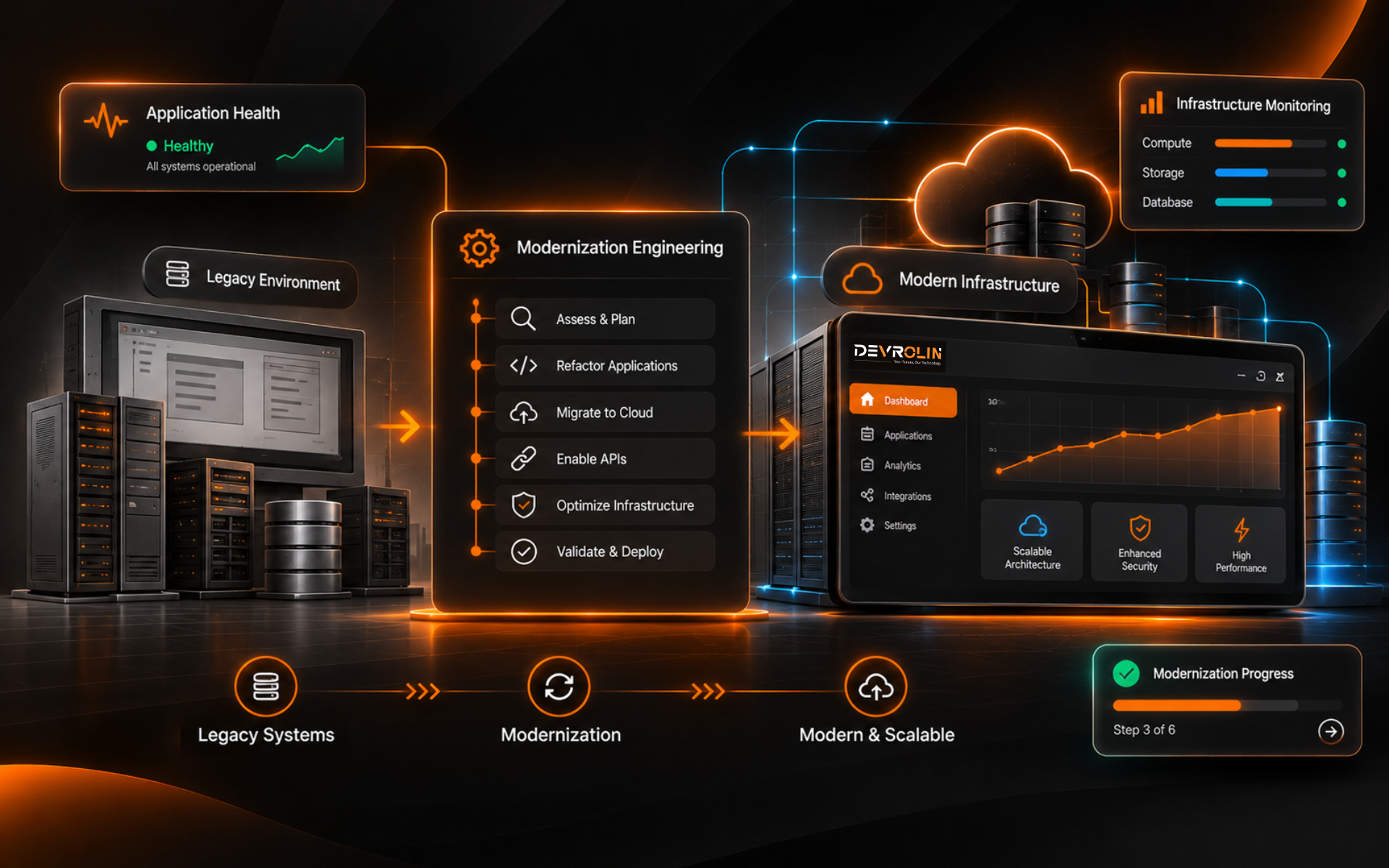
DevRolin combines engineering accountability with practical modernization experience — phased delivery that protects business continuity while reducing technical debt.
Aging platforms create operational and security concerns. Fragile systems consume time and engineering capacity. Disconnected applications restrict data flow and visibility. Tightly coupled systems make change harder to deliver.
Aging platforms create operational and security concerns.
Fragile systems consume time and engineering capacity.
Disconnected applications restrict data flow and visibility.
Tightly coupled systems make change harder to deliver.
These are intended business outcomes, not guaranteed results. Cloud migration does not automatically reduce cost; the architecture, usage model and operating practices matter.
Modernization should improve what the business can do — not just change where the software runs.
Cleaner architecture and maintainable codebases.
Monitoring, observability and dependable operations.
Modular design that makes change easier to deliver.
Clear view of resources, cost and performance.
API-first connectivity and scalable infrastructure.
Right-sized resources and ongoing optimization.
Include only services DevRolin can genuinely deliver and support with relevant engineering capability.
Discovery and roadmap
Application and infrastructure discovery, dependency mapping, technical-debt review, cloud-readiness assessment and a prioritized roadmap.
Workload migration
Workload migration, cloud environment setup, hybrid infrastructure planning and deployment preparation.
Refactor and restructure
Framework and runtime upgrades, code refactoring, application restructuring, monolith modernization and API enablement.
Containerize and scale
Containerization, orchestration, managed services, scalable architecture and deployment automation where justified.
Automate delivery
CI/CD pipelines, infrastructure as code, environment management and release automation.
Optimize and operate
Monitoring, resource optimization, reliability improvements, governance and ongoing maintenance.
Not every application should be rebuilt or moved to the cloud. The right path depends on business criticality, dependencies, cost, risk and future requirements. This decision framework is commonly known as the 7 Rs of migration.
Before: Decommission applications that are no longer needed.
Business outcome: Reduced infrastructure and maintenance cost.
Modernize applications without defaulting to microservices. A modular monolith may be a better fit for some systems.
Do not default to microservices. A modular monolith may be a better fit for some systems.
Public-cloud, hybrid-cloud and modernized infrastructure options. Name AWS, Azure or Google Cloud only where DevRolin has demonstrable delivery experience.
Architecture principles that guide every modernization decision.
Loose coupling, clear boundaries, maintainable codebases.
Services communicate through well-defined APIs.
Infrastructure that grows with the business.
CI/CD pipelines and infrastructure as code.
Visibility into performance, errors and cost.
Code that the team can understand and evolve.
Security and governance scoped to the client's industry, jurisdiction and workload. Avoid unsupported certification or compliance claims.
Security and regulatory requirements should be assessed for the client's industry, jurisdiction and workload.
The current DevRolin company profile does not establish a dedicated cloud or legacy-modernization case study. Do not manufacture one or imply unverified results. If a relevant project is available, structure it around: starting environment, technical problem, chosen strategy, engineering work, validation, verified outcomes.
Legacy on-premises infrastructure limiting scalability and increasing maintenance cost.
Phased cloud migration with hybrid infrastructure planning and minimal disruption.
Improved reliability and reduced maintenance overhead. Verify before publication.
Aging application with tightly coupled code and slow development cycles.
Code refactoring, API enablement and modular architecture redesign.
Faster delivery cycles and improved maintainability. Verify before publication.
Manual deployment processes causing delays and inconsistency.
CI/CD pipelines, infrastructure as code and release automation.
Reliable, repeatable deployments with reduced manual effort. Verify before publication.
Phased delivery that protects business continuity while modernizing systems.
Review applications, infrastructure, dependencies, constraints and business priorities.
Application & Infrastructure Assessment
Create a phased modernization roadmap, target architecture and migration strategy.
Modernization Roadmap & Business Case
Set up the target environment, access controls, deployment foundations and migration plan.
Ready Target Environment
Refactor, replatform, migrate or replace workloads according to the agreed strategy.
Migrated or Modernized Workloads
Test functionality, performance, security, integrations, data and operational readiness before transition.
Validated Production Transition
Monitor the environment, improve reliability and cost visibility, and plan ongoing operations.
Optimization & Operations Plan
Modernization should improve the business, not just change the technology.
We modernize in phases that protect business continuity without guaranteeing zero disruption.
Defined deliverables, clear milestones and regular progress visibility.
We recommend the right approach — not forcing every workload into microservices or Kubernetes.
Clear ownership, access and documentation throughout the engagement.
Ongoing optimization, monitoring and support as part of the engagement scope.
Start with the engagement that matches where you are in the modernization journey.
A focused first engagement: application and infrastructure discovery, technical-debt review, cloud-readiness assessment and prioritized roadmap.
Plan Your ModernizationFor organizations ready to execute: cloud migration, application refactoring, infrastructure setup and deployment.
Scope My ProjectFor modernized environments needing monitoring, optimization, governance and managed operations.
Discuss OperationsAll paid engagements receive a defined proposal and commercial terms before work begins.
Common questions before starting a modernization engagement.
Migration changes where an application runs. Modernization improves the application or its operating model so it better supports current and future requirements.